
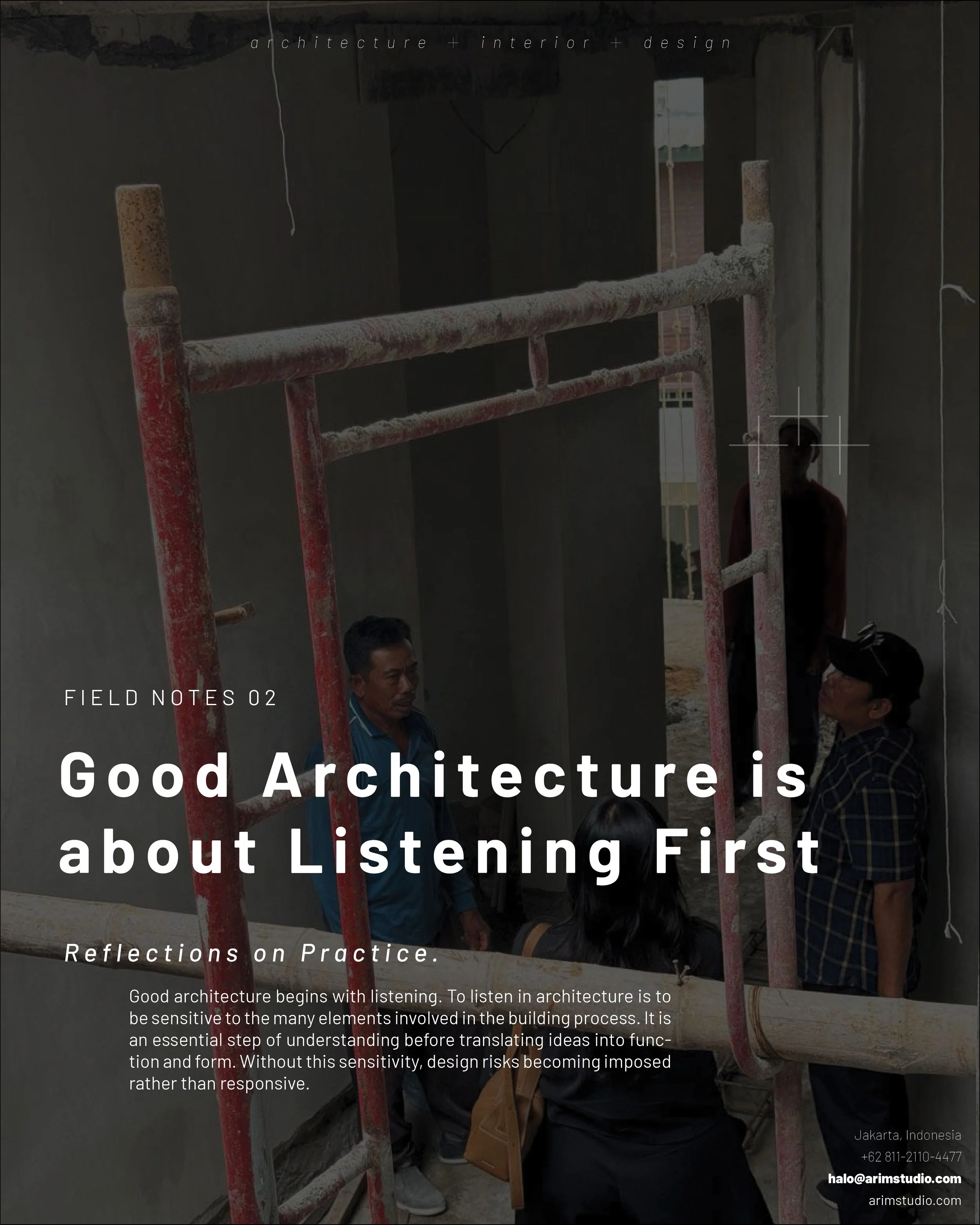
Good Architecture is about Listening First.
Good architecture begins with listening. To listen in architecture is to be sensitive to the many elements involved in the building process. It is an essential step of understanding before translating ideas into function and form. Without this sensitivity, design risks becoming imposed rather than responsive.
FIELD NOTE — Listen To It’s Context.
We begin by listening to context. Every site carries its own history and conditions that shape how a building should exist within it. This can be understood through three scales. At the macro scale, extending beyond a >5 km radius, we observe access, infrastructure, climate patterns, and future developments. At the meso scale, within roughly a <1 km radius, we begin to understand the surrounding environment—neighboring buildings, urban fabric, and elements that may influence the site’s performance. At the micro scale, we focus on the site itself: its contours, soil condition, orientation, and immediate physical qualities. Together, these layers form a foundation for a design that belongs.
FIELD NOTE — Listen To It’s Needs.
Listening then shifts toward human needs. Architecture ultimately serves people, where its carrying their routines, memories, and sensory experiences. Beyond functional requirements, there are emotional and spatial needs that shape how a place is lived. Understanding how people move, what they value, and how they wish to feel within a space allows design to respond with empathy.
In this way, architecture becomes not only a solution, but a support system for everyday life.
FIELD NOTE — Listen To Your Own Thoughts
Finally, we listen to our own judgments. This is where experience, knowledge, and awareness are tested. How deeply have we explored possible directions? How conscious are we of the implications behind each decision? Every design carries both potential and risk, what could succeed, and what might fail during construction or use. This internal dialogue reveals our level of sensitivity, care and mostly our carelessness. Guiding us to set priorities, make informed decisions, and recognize what might be overlooked.
In the end, listening is what grounds architecture. It connects ideas to reality, intention to experience, and design to those who inhabit it. When we listen carefully to context, to people, and to ourselves—architecture becomes more thoughtful, more responsible, and ultimately, more human.