
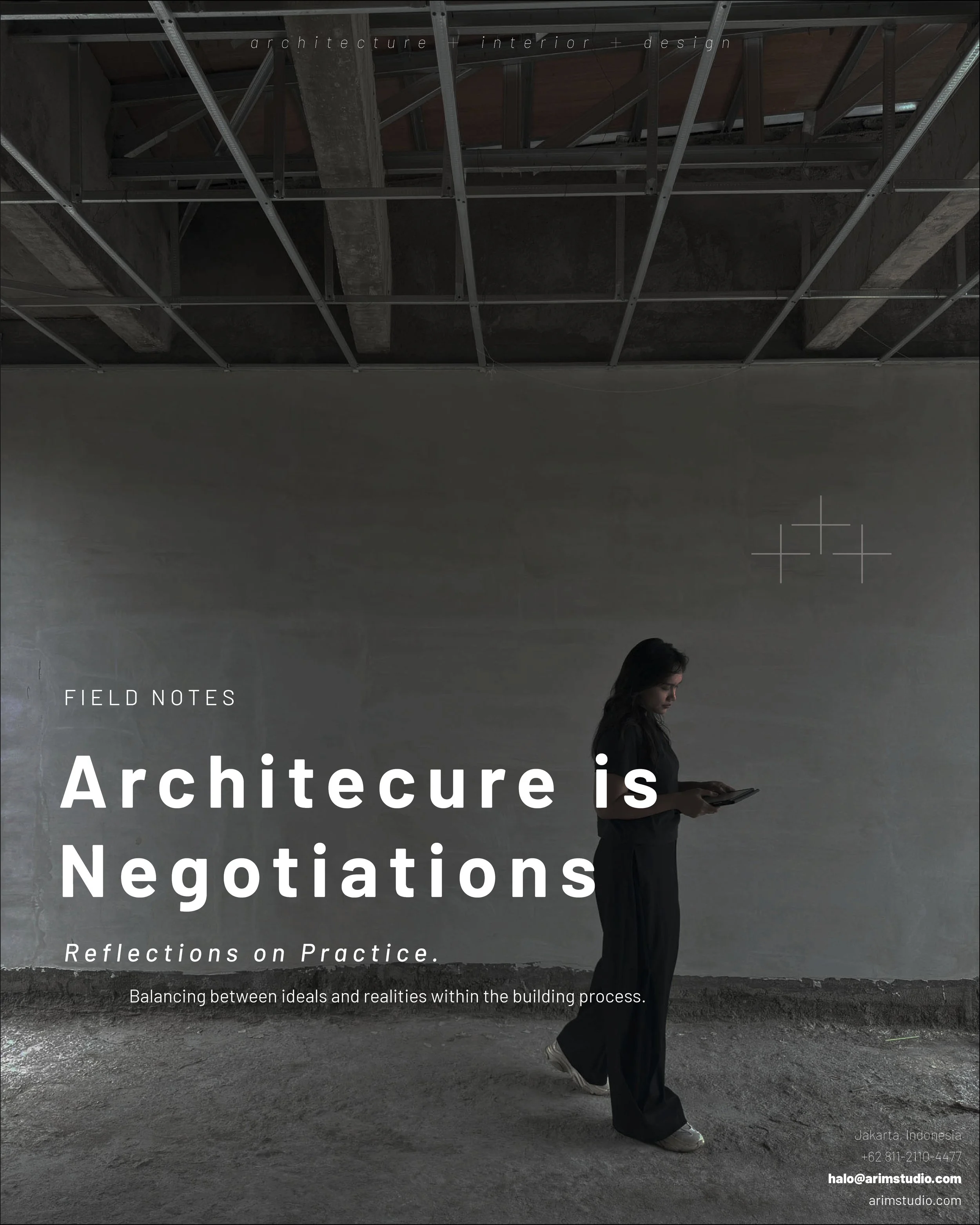
Architecture is Negotiations.
Balancing ideals and reality.
Architecture is mostly a process of negotiations, because it sits at the intersection of multiple realities. From contractor’s perspective, it grounded in buildability, details efficiency and executions. Engineers bring structural logic and its build performance. Clients carry expectations, budgets and personal taste. What begin as a clear design intention is gradually shaped by these different viewpoints. Architecture is negotiation in this case, is not to compromise what was imagined, but a process of aligning vision with what can realistically be built.
In this process, the role of the architect is to respond with clarity. It is essential to understand the core values of the design and to protect those architectural elements. I personally approach this by setting priorities; identifying the non-negotiable aspects, and establishing a hierarchy between spatial qualities, key details and material choices. This allows the negotiation to be lead and guided. Instead of resisting changes, the architect learns to navigate, knowing where to adapt and where to stand firm. So the essence we view important of the design remain intact.
Architecture and design in this case is about being realistic and empathetic. It requires an understanding of constrain, respect for those who build, and being sensitive towards the needs. When approached with empathy, negotiation becomes a collaborative effort rather than conflict, where it balances the intentions and reality. So that what gets built still carries the essence of what was first imagined.